
Hospitality developers increasingly seek architectural focal points that elevate guest dwell time and maximize spatial utility within high-end destinations. Among contemporary leisure installations, the double-decker carousel has transitioned from a traditional fairground apparatus into a premier kinetic centerpiece for five-star resorts, botanical estates, and integrated coastal complexes. Unlike single-tier configurations, these two-story mechanical structures deliver substantial verticality and simultaneous multi-generational throughput without expanding the ground-level footprint.
Architectural Gravitas and Spatial Optimization in Resort Planning
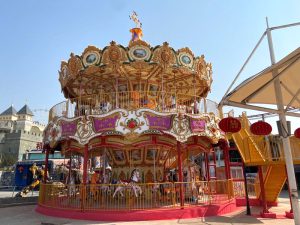
Resort master planners face persistent constraints regarding premium square footage. Every exterior courtyard or atrium must generate measurable aesthetic and commercial returns. Installing a multi-tiered carousel ride resolves this spatial dilemma by doubling passenger capacity within a compact diameter, typically spanning eleven to sixteen meters. The vertical elevation—often reaching heights between ten and seventeen meters—creates an immediate visual anchor visible across expansive resort grounds.
Architects utilize these structures to harmonize classical European ornamentation with modern structural engineering. Rather than appearing incongruous alongside marble colonnades or manicured topiaries, bespoke two-story carousels reinforce a property’s bespoke identity. Artisans fabricate individual mounts, chariots, and cornices from high-density fiber-reinforced polymer, applying multi-layered automotive-grade lacquers to withstand saline coastal air and intense ultraviolet exposure. Warm-spectrum architectural LED arrays replace harsh carnival strobes, bathing the gilded trim and hand-painted panels in an ambient luminescence after dusk.
Engineering Standards Behind the Modern Carousel Ride
Beneath the ornate filigree lies a sophisticated electromechanical drivetrain engineered for acoustic discretion and continuous duty cycles. Luxury hospitality environments enforce strict decibel thresholds to preserve guest tranquility. Consequently, modern installations abandon noisy pneumatic systems and exposed chain drives in favor of variable-frequency drives and precision-machined helical gearboxes. These components ensure smooth acceleration, silent rotation at approximately three to five revolutions per minute, and negligible vibration.
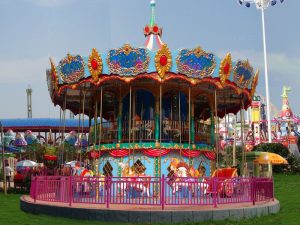
Structural integrity relies on hot-dip galvanized steel trusses and reinforced central columns capable of supporting asymmetrical dynamic loads across both decks. The upper platform connects via cantilevered radial arms engineered to eliminate harmonic resonance during full-capacity operation. Redundant electromagnetic braking systems, load-sensing relays, and perimeter photoelectric sensors enforce rigorous international safety compliance while remaining unobtrusive to passengers. Maintenance crews access internal crank mechanisms and slip-ring electrical assemblies through concealed hatches, ensuring routine lubrication and inspection occur outside guest sightlines.
Elevating Family Amenities Beyond the Standard Kiddie Ride
Affluent family travelers evaluate destinations based on the sophistication of all-ages programming. A standard kiddie ride frequently isolates young children in utilitarian play zones separated from adult leisure spaces. By contrast, a two-story carousel functions as an inclusive intergenerational venue. Parents and grandparents accompany younger guests onto the lower deck’s stationary chariots, while older children ascend the helical staircase to the upper tier for an elevated vantage point over the resort gardens.
This shared experiential value directly influences ancillary revenue and brand loyalty. Guests gravitate toward the structure during twilight hours, generating organic digital exposure through photography without overt promotional intervention. Hospitality operators frequently position boutique patisseries, champagne kiosks, or retail pavilions adjacent to the boarding perimeter, capturing high-margin foot traffic drawn by the attraction’s kinetic allure. Furthermore, the installation serves as a prestigious backdrop for private galas, weddings, and seasonal celebrations, offering event planners a distinctive venue asset.
Custom Manufacturing Capabilities of Beston Rides
Executing a turnkey installation of this magnitude requires close collaboration between resort architects and specialized amusement fabricators. Established manufacturers such as Beston Rides supply bespoke double-decker systems tailored to rigorous architectural specifications and regional climatic demands. Through comprehensive computer-aided design and finite element analysis, engineering teams customize diameters, seating configurations, and decorative motifs—ranging from nautical themes for beachfront properties to Baroque equestrian styling for heritage hotels.
Global procurement for luxury venues demands end-to-end logistical oversight. Beston Rides manages structural fabrication, non-destructive weld testing, and multi-stage factory commissioning prior to maritime containerization. Upon arrival at the resort site, dedicated field engineers supervise foundation anchoring, structural assembly, electrical integration, and load testing. This systematic project execution minimizes construction disruption on active hospitality properties while guaranteeing decades of reliable mechanical performance.
Long-Term Asset Valuation for Hospitality Portfolios
Capital expenditure committees evaluate recreational infrastructure through lifecycle durability and asset depreciation metrics. Unlike ephemeral entertainment trends or rapidly aging electronic attractions, a properly maintained double-decker carousel retains enduring cultural resonance and structural longevity. Galvanized structural frameworks and replaceable fiberglass components yield operational lifespans exceeding fifteen years with predictable preventative maintenance budgets. By integrating high-capacity mechanical artistry into their master plans, luxury resorts secure a permanent architectural landmark that differentiates their brand within an increasingly competitive global hospitality market.